
- Problem: A reading intervention teacher needed to create customized spelling lists that were time-consuming to make manually.
- Solution: An instructional coach and the teacher used AI to build a custom prompt that automatically formats spelling lists.
- Outcome: The new process saves the teacher significant time, highlighting instructional coaching as a thought partnership.
Educators are constantly looking for ways to innovate their practice while also managing a demanding workload. One of the most significant challenges is finding or creating resources that are not only effective but also time-efficient to prepare. For a reading intervention teacher, crafting differentiated spelling lists that break down words by syllable and color-code specific sounds is a powerful instructional strategy, but it’s incredibly time-consuming. Imagine manually creating these lists for every student, every week. It’s a task that can quickly become overwhelming.
A recent coaching partnership with an intervention teacher brought this exact challenge to light. She wanted to create custom spelling lists that were more than just a list of words. Her vision was a list that visually supported her students by:
- Breaking down each word into syllables.
- Color-coding long and short vowel sounds.
- Highlighting digraphs.
While she had been doing this manually in Google Docs, the process was a significant drain on her time. The question became, “How can we streamline this without sacrificing the instructional quality?”
This is where the power of thought partnership truly shines. Rather than simply providing a tool, the goal was to co-create a solution. We considered various digital tools, but none offered the specific customizations she needed. We realized the solution wasn’t a pre-built app, but a new approach to an existing one: AI.
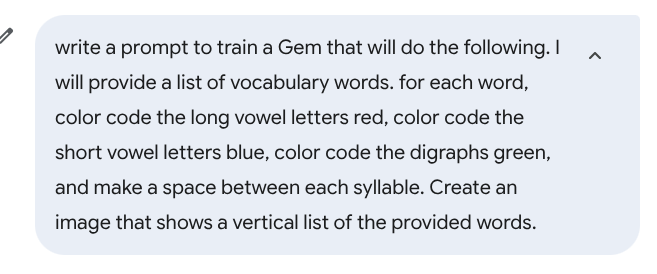
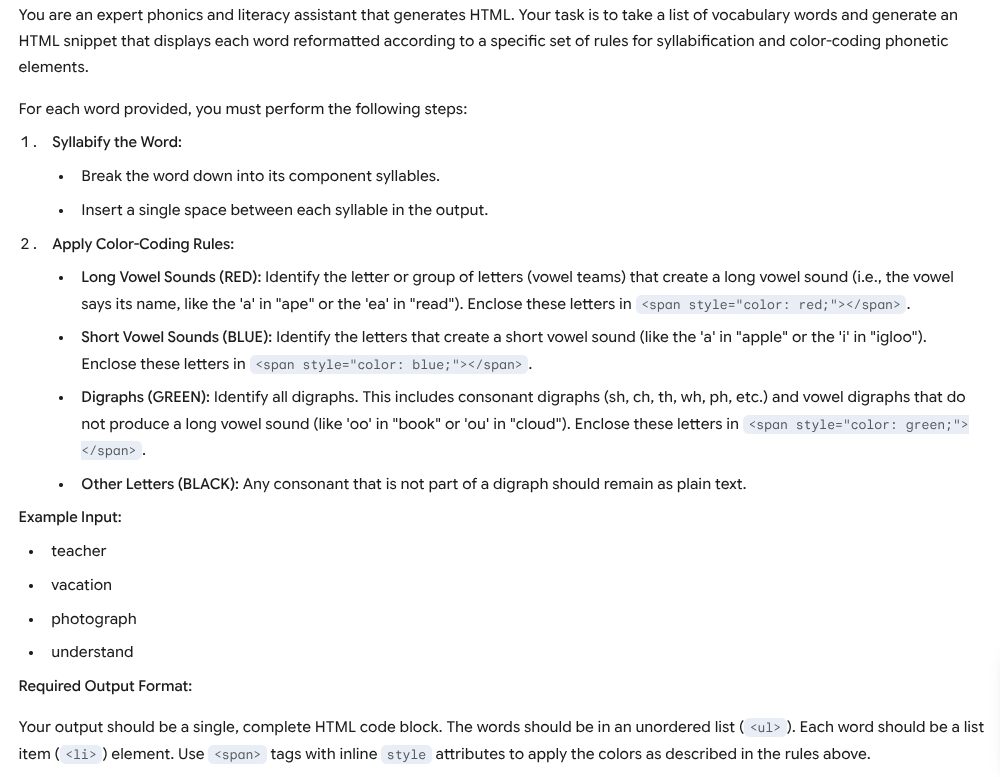
We decided to “MacGyver” a solution using Gemini. The idea was to create a specialized prompt that could be used in an AI like Gemini. This prompt would essentially train the AI to act as a custom tool. The final prompt was crafted to instruct the AI to:
- Take a simple list of spelling words.
- Generate HTML code that would format the list.
- Break down each word by syllable.
- Color-code the specified vowel sounds and digraphs.
The generated code could then be easily copied and pasted directly into a Google Doc, creating a perfectly formatted, customized spelling list in seconds.

This process highlights a key aspect of instructional coaching. It isn’t about the coach having all the answers. It’s about being a thought partner with the educator. We didn’t just find a tool for the teacher; we used our combined expertise to innovate and create one. The result was a workflow that empowers the teacher to quickly generate high-impact instructional materials, freeing up valuable time for what matters most: working with students. This is the essence of EdTech integration: not just using a tool, but using it thoughtfully to enhance teaching and learning in meaningful ways.
This blog post was drafted with the help of Google Gemini to help organize and flesh out my thoughts and ideas regarding the thought partnership aspect of instructional coaching and how to use Gemini to create these types of specific spelling lists. I also used NotebookLM to generate a deep dive audio overview, perfect for those who want to listen and learn on the go.
If you enjoy this blog, you’ll love our new book, History Matters in an AI Era. Available now on Amazon, this book shares practical, research-based strategies for integrating technology into history lessons. You’ll learn how to use technology to increase student engagement and curiosity. Click here to get your copy today.

Leave a comment