
- Technology bridges language barriers for students in the classroom.
- A student’s resilience and determination lead to significant academic and personal growth.
- Empowering educators with EdTech strategies creates opportunities for student success.
What happens when a student faces a language barrier but refused to let it hold her back? You got a powerful reminder of how technology, paired with a resilient spirit, unlocked opportunities for learning and growth.
Recently, I encountered a new fifth grade student who spoke very little English, but she was fluent in her mother tongue of Arabic, reading and writing with relative ease. That alone was an incredible strength, but in a new classroom environment, she understandably felt isolated at times. As she prepared for her state research project on Canva, I wanted to help make sure she had a way to engage fully.
Someone had already introduced her to Google Translate, but I noticed that typing or using the standard voice input did not quite feel natural for her. That is when I showed her the Conversation Mode on the Google Translate mobile app. Her eyes lit up. This feature felt different, more like an actual dialogue. She could speak and listen more fluidly, which created a sense of connection that typical translation tools often lacked.
Click here to view a video to see how to access and use Google Translate Conversation Mode.
With the state research project underway, her assigned state was Louisiana. She pulled up the Canva slides she was assigned to remix. Using the mobile conversation mode on my phone, she was able to ask me questions in Arabic and listen to my responses in English which were promptly translated back to Arabic. To stay organized during the research process, she used her whiteboard to jot down the parts of each slide she needed to research.
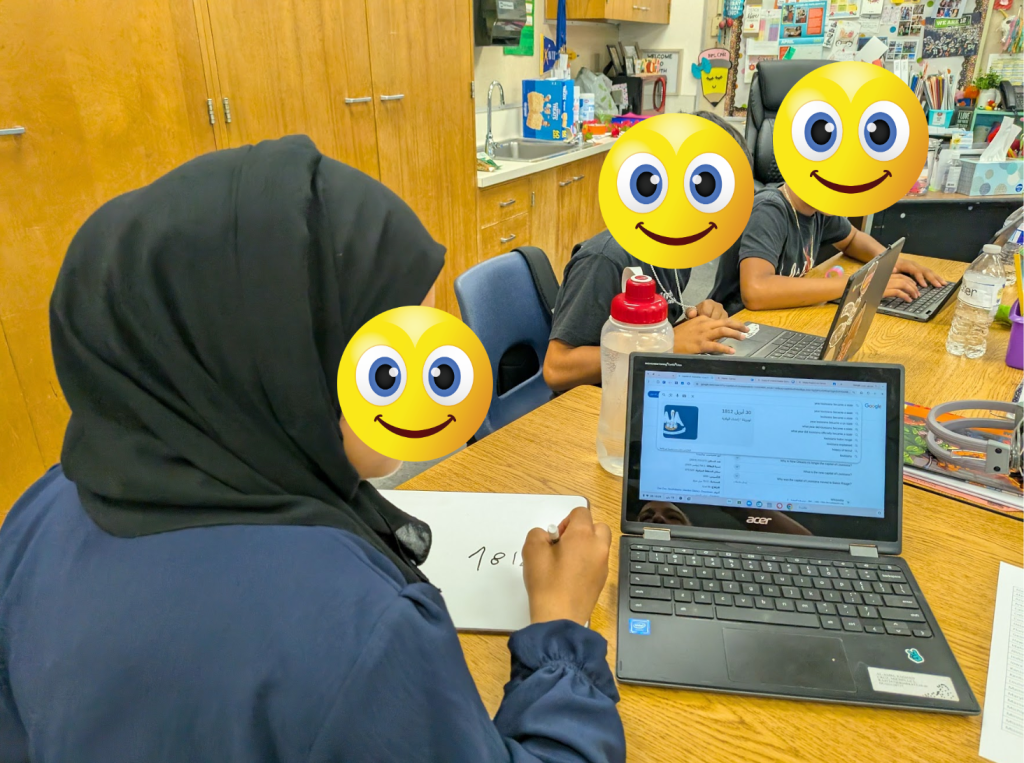
From there, she opened a new tab in Chrome, which was set up to display both English and Arabic. She typed the research topics from her whiteboard into the search bar, navigated to age-appropriate sources, and found the answers she needed, all while navigating two languages. As she engaged in her research, she wrote the answers back on her whiteboard and then carefully transposed them into the corresponding slides on her Canva slide deck.
The result? A thoughtful, creative, and complete project on the state of Louisiana. But more importantly, a major confidence boost and a real sense of accomplishment.
This experience showcased so much more than language support. It revealed her grit, resiliency, and resourcefulness. It would have been easy for her to give up because of the language barrier, but she was determined to use the tools available to her and the teachers to engage as best as she could. She stayed motivated, focused, and determined to succeed, using every tool available to her to bridge the gap. And at the heart of it all was Google Translate’s Conversation Mode, empowering her to ask questions, seek answers, and be an active part of the learning process.
At the end of the project, she smiled and thanked me for showing her that tool. She was proud. And she should have been.
This story is a powerful reminder that when we teach students how to access the tools they need, we are not just supporting them, we are helping them thrive. Language barriers do not have to be walls. Sometimes, with the right tech and a little guidance, they can become doorways to discovery.
This blog post was drafted with the help of ChatGPT to help organize and flesh out my thoughts and ideas regarding the encounter with this student using the Google Translate Conversation Mode. I also used NotebookLM to generate a deep dive audio overview—perfect for those who want to listen and learn on the go.

Leave a comment